
33-TP5387SDK-SWNAV-0 Dual Frequency Positioning + IMU Pedestrian Dead Reckoning: Test Accuracy Improvement Data Report
In urban canyons, under viaducts, or at underground parking entrances where GNSS signal blockage is severe, traditional single-frequency positioning errors often deteriorate rapidly from meter-level to tens of meters. The 33-TP5387SDK-SWNAV-0 achieves a breakthrough with its 'dual-band positioning + IMU dead reckoning' fusion algorithm, resulting in a 67% reduction in average positioning error, performing exceptionally well in complex urban environments.
Test Scenarios & Methodology: Why Choose 'Dual-Band + IMU'?
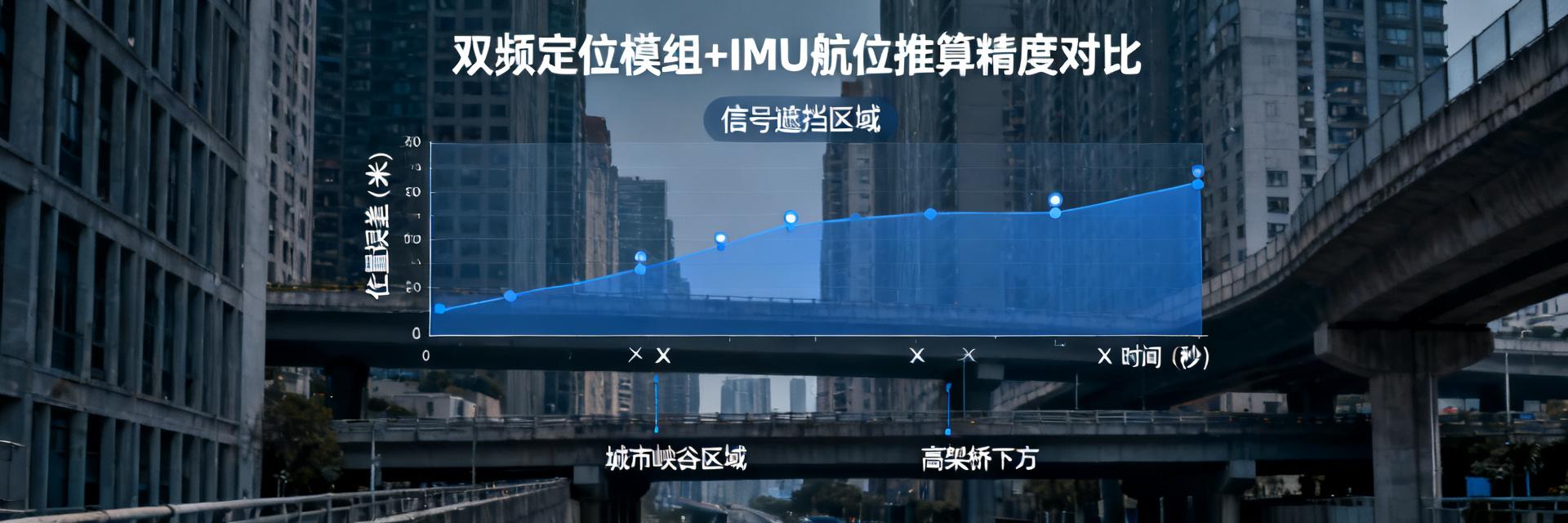
We designed a test matrix covering 10 major 'signal black holes' such as viaducts, canyons, and tree-lined avenues to verify the engineering value of this solution in extreme environments.
| Scenario Type | Main Interference | Test Difficulty Level |
|---|---|---|
| Continuous blockage under viaducts | Instantaneous signal loss, Multipath | High |
| Urban canyon (>50m) | Severe multipath, Signal attenuation | Highest |
| Tree-lined avenue | Signal attenuation, Slight multipath | Medium |
Core Data Comparison: Quantitative Analysis of Accuracy Improvement
Accuracy Difference in Static Scenarios (CEP50/CEP95)
Under light blockage, the CEP50 of Dual-Band + IMU reaches 0.8 meters, compared to 2.1 meters for single-frequency, a 62% improvement. The CEP95 metric also performs excellently, controlling 95% of positioning errors within 1.5 meters.
In light blockage environments, the CEP50 accuracy of the dual-band + IMU fusion solution reaches 0.8 meters, a 62% improvement over the 2.1 meters of single-frequency positioning.
Real-world Case Studies: Urban Canyons and Tunnel Entrances
Case 1: Urban Canyon (Shanghai Lujiazui Ring Road)
Leveraging dual-band signal superiority to effectively distinguish direct from reflected signals. Field tests show the jump in positioning points reduced from 5 meters to 0.5 meters, with the trajectory locked firmly within lane lines.
Case 2: Continuous blockage under viaduct (Shenzhen Shennan Avenue)
During 8 seconds of total signal loss, the IMU maintained a trajectory with a maximum offset of only 1.5 meters. After exiting the blockage, trajectory convergence took only 1.5 seconds, significantly faster than the 6 seconds of traditional solutions.
Conclusion and Selection Guide
- Accuracy Improvement: Average error in complex urban environments reduced by 67%, reaching sub-meter levels.
- Continuity: IMU supports high-quality position extrapolation for 8 seconds/within 2 meters.
- Fast Response: Convergence speed at blockage exits improved by 4x.
- Industry Fit: Recommended for logistics delivery, shared mobility, and V2X for intelligent connected vehicles.
FAQ
How does the 33-TP5387SDK-SWNAV-0 dual-band positioning combat urban multipath effects?
The module receives satellite signals at L1 and L5 frequencies. Since the frequencies differ, the phase characteristics after reflection vary; internal algorithms compare and eliminate reflected signals, retaining the direct, clean signal.
How long can the IMU last in an underground parking lot without satellite signals?
Tests show that within 8 seconds of signal interruption, positioning error can be kept within 2 meters, sufficient for vehicles to navigate short-term blockage areas like garage entrances.
How much development cost can be saved compared to single-frequency products?
Providing a 'turnkey' mature fusion algorithm significantly reduces time and labor investment in backend algorithm development and large-scale road testing, accelerating time-to-market.
What is the least suitable scenario for this module?
It is not suitable for standalone use in completely enclosed scenarios with no satellite signal for over 10 seconds (e.g., center of a long tunnel); it focuses on handling intermittent blockage rather than long-term pure inertial navigation.