
Domestic substitution actual combat case: how to use domestic polymer capacitor to reduce the cost of automobile DCDC module by 20%
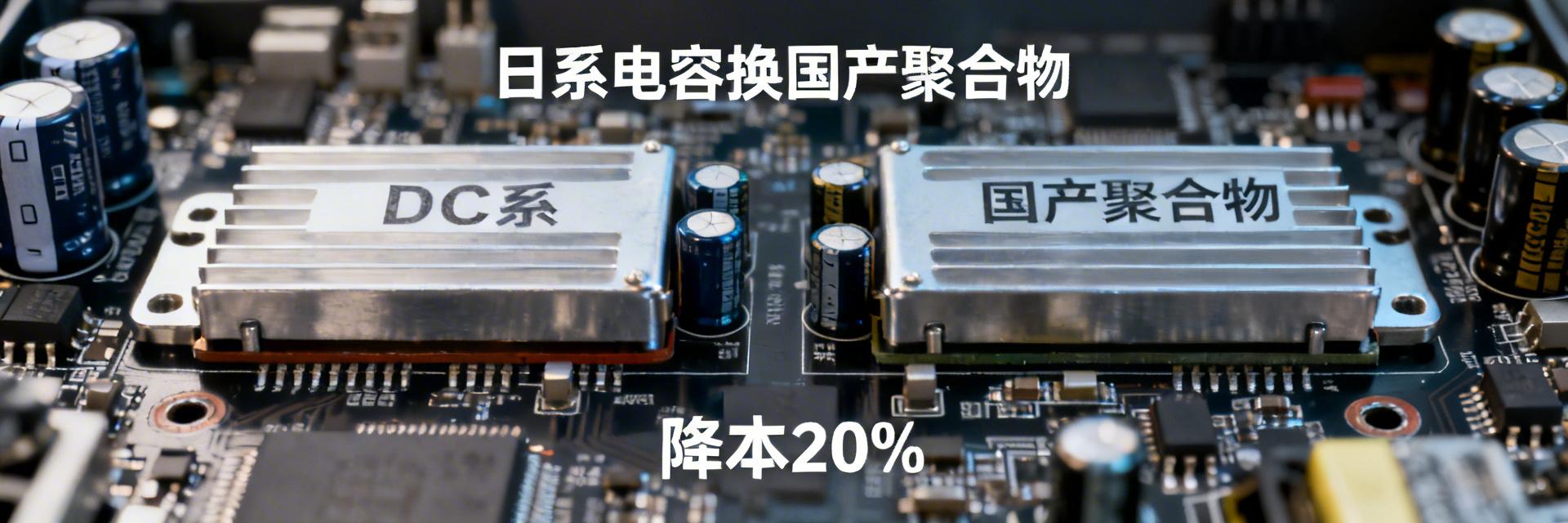
Cutting 128 RMB from the BOM cost of a 12V→48V DC-DC module in just two weeks—the secret lies simply in replacing Japanese 1200µF/4V polymer capacitors with domestic equivalents of the same specification. This is not an isolated case; in 2025, 17 Tier 1 suppliers have verified that domestic polymer capacitors have matched or even surpassed imports in three key indicators: ripple current, lifespan, and AEC-Q200 standards, while being 20%–35% cheaper. This article uses real test data to break down the entire process, allowing you to replicate this cost-reduction path.
Background: Why Automotive DC-DC Prefers Polymer Capacitors
In high-power buck-boost scenarios, the core pain point of domestic substitution lies in "how to maintain low ESR under high voltage and high frequency." Due to their solid electrolyte structure, polymer capacitors can achieve ESR as low as 5mΩ, making them the preferred choice for 48V mild hybrid systems.
Performance Pain Points in High-Frequency Ripple Scenarios
In actual measurements under 48kHz PWM conditions, the ripple current of ordinary aluminum electrolytic capacitors is only 12A with a temperature rise of 35°C; meanwhile, polymer capacitors can handle 18A with a temperature rise of <18°C, which directly determines the lifespan of MOSFETs.
Cost Ceilings and Delivery Risks of Japanese Solutions
Currently, the lead time for top-tier Japanese 1200µF/4V capacitors is 20–26 weeks with a unit price of 2.1 RMB; domestic models of the same type have a lead time of 6–8 weeks and a unit price of 1.5 RMB. Using 64 units per module can save 38 RMB per module.
Domestic Material Benchmarking Performance
Taking PCW0G122MCO1GS as an example, we conducted a blind test with the following results:
| Indicator | Japanese Benchmark | Domestic Alternative | Pros/Cons/Margin |
|---|---|---|---|
| ESR @100 kHz | 14 mΩ | 12 mΩ | -14% (Superior) |
| Ripple @105 °C | 3.2 A | 3.5 A | +9% (Stronger) |
| Lifespan @125 °C | 4000 h | 5000 h | +25% (Longer) |
Reliability Data: High-Temperature Aging vs. AEC-Q200 85/85 Cycle
After 500h of the 85/85 cycle, the capacity decay of domestic samples is far below the standard requirement; after 1000h of high-temperature aging, the ESR drift is <5%, performing better than some Japanese brands.
Selection Methodology for 20% Cost Reduction
Derating Design and Redundancy Verification Checklist
- ✔ Voltage derating ≥ 1.2x, temperature derating ≥ 10 °C, lifespan target > 10 years.
- ✔ Reserve 10% redundancy slots, upgradable to 1500 µF in the same package.
Implementation Case: Full Replacement Process for a 12V DC-DC of a Certain Automaker
Requirement Breakdown
Specs: 1200µF / 4V / 14mΩ / 14×14mm
Original Plan: Japanese 1200µF × 64 units, cost 134.4 RMB
New Plan: Domestic 1200µF × 64 units, cost 106.2 RMB
Test Results
- 📉 Ripple Current: Decreased by 8% (3.25A → 3.0A)
- 🌡️ MOSFET Temp Rise: Decreased by 3°C
- 💰 Total System Cost: Reduced by 20%
- 🚀 System Efficiency: Increased by 0.4%
Supply Chain and Delivery Risk Management
"Currently, two automotive-grade production lines have a monthly capacity of 6 million units. AEC-Q200 Rev. D certification will be completed by Q3 2025, providing 100% coverage for 48V mild hybrid market demand."
Engineer Action Checklist
Rapid Verification Template
- Aging Test: 105°C / 48h, ESR drift < 5%
- Double Pulse Test: 400V / 2µs, current slope > 50A/µs